

Teamwork at the ‘Violette Brücke’ in Duisburg
Countless bridges connect the banks of the Ruhr river basin. This is also the case in Duisburg, where four adjacent railway bridges spanning the Ruhr Canal have been given colour names to distinguish them from one another. After the ‘yellow’ bridge was replaced a few years ago, it was now the turn of the ‘violet’ bridge, a truss railway bridge dating from 1917. No easy task for the bridge team at Wagenborg Nedlift!
Antique bridge
‘Moving a 106-year-old bridge presents its own set of challenges,’ begins Arjan Bossers, project manager at Wagenborg Nedlift. ‘The bridge had reached the end of its service life. That means the structure may no longer be equally reliable in all areas. It was therefore essential to use the right method to safely move the central section of the bridge.’
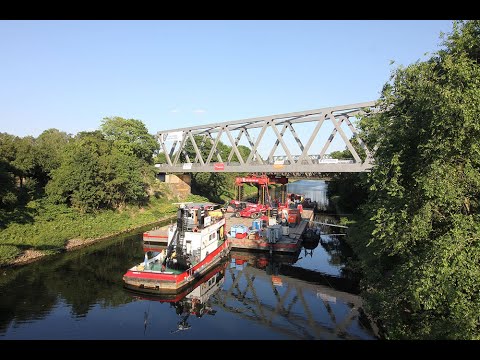
To do this, we built two large container supports on our SPMT trailers. The SPMTs with their support structures were in turn positioned on a barge provided by our colleagues at Wagenborg Towing. This allowed us to sail underneath the central section of the bridge. Prior to the sailing operation, our lifting team had also removed the approach bridges using the 500-tonne and 700-tonne mobile cranes.’


A tense moment
Then came a tense moment: detaching the bridge from the abutments. ‘Fortunately, the dismantling specialists had already made the necessary preparations,’ continues colleague Alwin Schuitema, site manager and responsible for operational management on this project.
‘Using the trailer’s hydraulics and a ballast operation with the pontoon, we were able to lift the bridge off the abutments without any problems and then rotate it 90 degrees. Using the JS250 box jack system, the bridge was then lowered by 10 metres so that it came to rest on the pontoon at working height. The dismantling company then took it apart.’
Watch the project videos here!


In-house sliding system
The new railway bridge, a colossus 110 metres long and weighing 900 tonnes, was already in place on the construction site next to the track. ‘Once the old bridge had been dismantled and removed, we prepared the pontoon for the sliding-in operation of the new bridge. A completely different method to the floating-out operation,’ said Alwin.
‘First of all, we reassembled the JS250 box jack system on the pontoon,’ adds Jordy Batema, an assembly worker. ‘This handy and ergonomic system is very strong and a godsend for this bridge, which we jacked up to a height of 10 metres.’ Warre te Riet Scholten, an engineer on the project: ‘The new sliding system was placed on top of the box jack system. We developed this sliding system in-house with our own team of engineers to enable bridges like this one to be slid into position conveniently and safely.’

The new sliding system is a great addition to our other bridge installation techniques. It’s been a real godsend for this project!
Warre te Riet o.g. Scholten, engineer

Take over
Meanwhile, work was also in full swing on the land side. Henrie van den Berg, Transport Site Manager: ‘The SPMTs were deployed on the land side to manoeuvre the bridge. We erected the Modular Support System on top of the SPMTs. And on top of that, we also installed our sliding system, or “Verschubwippen” as they so aptly call it in German.’
‘The operation to float the new bridge into position took us several days. This was because it took place in several phases,’ explains Arjan. ‘The bridge had to be “repositioned” a number of times during this process. The Wagenborg sliding system, in combination with a set of beach jacks, was indispensable for this: it was used to slide the bridge across the canal. Finally, we positioned the bridge on the abutments and our work was done.’
See how the new Violette Brücke has been installed
De Wagenborg approach
‘With a multifaceted and complex project like this, we involve the whole team at an early stage,’ says Arjan. ‘For example, Alwin and Warre joined the discussions with the client and carried out site visits at the project location. And Henrie shared his views on the transport solution that had been developed.
We incorporate the experiences and input of our practitioners during the preparation phase, ensuring the team is already well-coordinated before work begins. You really notice the difference during implementation. And once a project is completed, there is always an internal project evaluation. We take the areas for improvement identified from this into account for future projects. This is how we grow as a team and as a company.’

Together, they rolled up their sleeves and made sure this challenging task went smoothly. An achievement I’m proud of!
Arjan Bossers, projectmanager